 Viewed: 55
This article is translated from the Chinese-language original of
Commentary on China's Wine Industry, Volume 1.
On the early morning of July 24, 2025, the car departed from Zhongwei heading towards Yinchuan. It happened to be a rare rainy day in Ningxia, and the weather was exceptionally cool. I was scheduled to take a flight back to Guangzhou at 4 p.m. that afternoon, with a planned stop at HolyFun (Helan Fanghua) Vineyard along the way. As the car passed through Ganchengzi in Qingtongxia, the rain began to intensify. Dark clouds hung low in the sky, and the silhouette of the Helan Mountains in the distance, set against the grey-blue cloud layers, appeared increasingly majestic and vast.
This is a land kissed by time. In 2011, when the wine industry in the eastern foothills of Ningxia's Helan Mountains was just beginning, Mrs Wang chose to plant the roots of HolyFun here.
Originally, I had an appointment with the young proprietor, Ma Yao. We met at a Ketong roundtable forum. After the forum, he initiated a conversation, and we exchanged WeChat contacts but had no further contact afterward. When the interview recording project team began specific task assignments, HolyFun was immediately on my list, primarily due to a regret from my student days.
During my Ph.D. studies at The Hong Kong Polytechnic University, my research topic was the embodied experience of Chinese wine tourists. My mentor, Professor Liu, as my co-supervisor, suggested I conduct more fieldwork in Chinese wine regions. This directly led to my first research trip to the Ningxia wine region in 2022, with HolyFun among the wineries on my itinerary. However, as Proprietor Wang was not in the region at that time, I missed the opportunity to visit HolyFun. Now, with a chance to restart the interviews, HolyFun was naturally not to be missed.
This time, I had originally arranged to meet Young Proprietor Ma Yao at the winery, thinking it would be great to present the perspective of a second-generation proprietor. Unexpectedly, upon arriving in the region, just one day before our scheduled meeting, Ma Yao had urgent business and could not return to Ningxia. However, his mother, Ms. Wang Xinwen, happened to be at the winery these days. I immediately began making new arrangements.
This was already the tail end of our Ningxia trip. Just a day earlier, I had almost given up on the idea of completing the HolyFun proprietor interview within the region. Who would have thought that just when all hope seemed lost, a new path would appear!
This interview with Proprietor Wang was both unexpected and seemingly predestined, as if fate intended this rainy-day journey to perfectly conclude my series of Ningxia proprietor interviews.
1. On Cross-Border Investment in Wine
"Subconsciously, I liked wine. I thought owning a vineyard was a very cool,
enjoyable, and happy thing. I was completely unaware that it was an industry."
(Xinwen Wang )
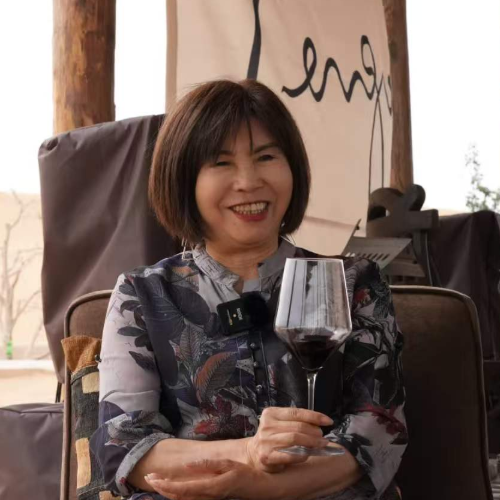
Although I had previously watched Proprietor Wang's video channel "Wine Sister's Vineyard" and felt I already had some understanding of her, meeting her in person for the first time offline provided a much greater volume of information. Her sincerity, candor, and enthusiasm were hard to fully perceive through online videos.
As a typical cross-border proprietor, the first half of Ms. Wang Xinwen's career had no connection to wine: a finance major, a former senior executive at a state-owned bank, later venturing into the medical device industry. In 2011, a chance opportunity arose when, on a friend's suggestion, she began considering investing in a vineyard in Ningxia. She decided to purchase this vineyard located in the Ganchengzi sub-region of Qingtongxia in just 15 days. The 800-mu old vineyard had vines planted in 1998, already over a decade old at the time, qualifying as old vines within the entire region.
"Because at that time, my understanding of wine was merely as a consumer product, a rather likable, elegant beverage, a social tool. It could add liveliness to social interactions, but I had not elevated it to the level of an industry at all," Proprietor Wang admitted that her decision-making speed back then was indeed very fast. Compared to others who would conduct thorough feasibility studies and vineyard planning beforehand, she boldly entered a completely new field almost solely driven by passion, with almost no knowledge of wine or the wine industry. "This led to a huge contrast later in the management process."
Shortly after purchasing the vineyard, in 2012, the Ningxia government organized the first International Winemaker Invitational Competition. Independent winemaker José from Spain took a liking to HolyFun's old vineyard. Proprietor Wang, also in need of professional expertise, found a perfect match, and thus began an eight-year collaboration. "After he arrived, he took care of (the vineyard) for me here, handling everything from viticulture to winemaking."
This heaven-made partnership laid a solid foundation for the winery's quality. HolyFun's professional reputation also began to be established from that time. "2016 was the most glorious time for our winery. The government organized three major awards, and we won all of them—a triple crown. The government organized participation in Decanter (World Wine Awards). We scored 90 points then, a Silver Medal, which was considered the highest award in Ningxia at the time." However, from 2012 to 2016, HolyFun had never actively sold wine externally. Initially, José thought the proprietor intended to age the wine before releasing it to the market, but the actual situation was different.
Proprietor Wang said with a laugh, "I had absolutely no market awareness; I didn't know I had to sell wine." When the cellar could no longer accommodate the new vintage's wine, HolyFun was forced to begin commercial wine sales. "Then I realized selling wine was so difficult. Compared to growing grapes, making wine, even compared to buying this vineyard back then, selling wine was truly too hard." During the most difficult years of 2017 and 2018, the hardship of market sales once made her almost want to give up on HolyFun.
A turning point came in 2019. Due to pandemic lockdowns, José could not return to China from Spain. Proprietor Wang was forced to move back to the winery to take over daily management. It was from this time that she fell in love with life at the winery. "When you come here, you feel free, completely unfettered. Every morning you hear the birds singing, your heart feels joyful. Walking through the orchard every day makes you feel especially energetic. At that time, I felt this was the life I wanted to live." This vineyard, with the spirituality and vitality of nature, firmly anchored Wang Xinwen. She says she is now deeply passionate about the wine industry. "I will absolutely not leave this land. I must stay here."
2. About Spanish Winemaker José
"José insisted that he must manage the viticulture. 'If I don't manage the viticulture,
I cannot make good wine.' That's a major difference."
(Xinwen Wang )
Unlike many local wineries in the eastern foothills of the Helan Mountains, HolyFun collaborated with an international winemaker from the very beginning. When asked about the differences between international and local winemakers, Proprietor Wang believes the understanding of the relationship between viticulture and winemaking is the biggest distinction. From the start of his involvement with HolyFun in 2012, Spanish winemaker José insisted that the winemaker must manage the viticulture. He emphasized that good wine depends on good grape raw materials. In his view, a winemaker who does not manage viticulture is unimaginable.
Furthermore, his hands-on approach in winery management and strict attention to detail left a deep impression on Wang Xinwen. "After he came, he did everything himself, including harvesting. He went to the fields every day, biting grape seeds to check ripeness. Regarding harvesting, his attitude was to pick one block when it's ripe."
During fermentation, José stayed in the winery all day. "Every day until midnight, even staying up until one or two in the morning, he remained in the winery. He completely immersed himself, very dedicated, very simple, and diligent." During the years José was responsible for winery management, the quality of the wine produced was excellent, winning numerous industry awards, thereby establishing HolyFun's standing in the eastern foothills of Helan Mountains region and even within the entire Chinese wine industry.
As an international winemaker, José chose winemaking as his profession very early. For this, he completed his undergraduate studies at an agricultural engineering university, followed by a master's course in viticulture and oenology at the Bordeaux Institute of Oenology. Starting as a winery intern, then assistant winemaker, he eventually became an independent winemaker. Before coming to Ningxia, José had made wine in several world-renowned regions, including Bordeaux in France, Napa Valley in the USA, and Mendoza in Argentina.
Regarding terroir, José had his own understanding and convictions. Concerning the cultivation and practice of non-burying grape varieties by some wineries in the region, José tended to favor following nature and respecting tradition. "Burying vines is a characteristic of Ningxia's terroir. Why try to change it? Perhaps the quality of Ningxia's grapes is related to burying. They don't consume energy during winter; when spring comes, they burst forth with accumulated strength, just like a snake that needs hibernation—full of vitality when spring arrives. If the climate hasn't changed, why should humans change it?"
In terms of winemaking, José advocated for minimal human intervention. He believed Ningxia grapes were very healthy. Under such conditions, "What the grapes originally are, what kind of wine they should be able to make, guide them according to their potential, give them some help, let them ferment, and the resulting wine will be very good. Don't always be adding yeast, using tartaric acid—he was very opposed to that."
3. About the Chinese Wine Consumption Market
"I don't like the term 'marketing'—not at all. What truly moves people about a product is still integrity,
meaning exceptionally good quality and a price everyone can accept."
(Xinwen Wang )
Although HolyFun has won numerous awards, Proprietor Wang has a clear understanding of the role and influence of awards. "You can only be validated by the market. It's not about what experts think; that is completely not the market's standard. The difference between expert ratings and market acceptance is still quite large."
Transitioning from fundamentally not knowing a winery was responsible for selling wine to finding a market path that suits HolyFun's characteristics, Proprietor Wang adheres to the principle that the greatest truths are the simplest. She dislikes flashy marketing jargon and gimmicks, placing high-quality products, acceptable prices, and excellent service at the core of the winery's development. "Without these, if you're always playing tricks, playing with business models, playing with marketing techniques, I think that's all fleeting."
Regarding whether consumers and the market can distinguish quality wine, Proprietor Wang firmly believes, "In accepting beauty and goodness, people have common ground. Although tastes may be high or low, there is common ground." Because of this, coupled with the safety attributes required of wine as a food product, Proprietor Wang emphasizes that wine should not be excessive—including excessive winemaking and excessive packaging should be avoided. Simply present its essence with care. "I think if you grasp this point, the market will gradually expand. A single spark can start a prairie fire."
For future market expansion, Hong Kong and Beijing will be key target markets for HolyFun. Whether in terms of economic income or cultural awareness, these places have consumer groups that match HolyFun's wines, especially Hong Kong. "They are not at all rejecting of domestic wines. They are surprised to see Ningxia wine and discuss it with you after tasting. So I think Hong Kong is a place that really knows how to drink wine. I've always wanted to get our wine into Hong Kong."
Outside the window, the rain continued to fall incessantly. On the indoor solid wood long table, hollyhocks of varying shades placed in wine bottles, brimming with the vigorous vitality from nature, freely stretched out, blooming with an indescribable strength and beauty, much like this vibrant vineyard.
The owner of HolyFun Vineyard, this female proprietor who made a splendid transition from a finance elite, from initial casualness to current conviction and perseverance, has long become the most loyal fan of nature and the land beneath her feet in this journey of listening to the land's breath. And this terroir experiment has already borne abundant fruit over the years.
Xinwen Wang says, "Actually, my vision for HolyFun's future is to make it the most beautiful winery in China, to add and create beauty for people's lives."
Reference
Xiaoyu Xu,Yibin Lan,Zhangyu Wang,Yongce Huang,Ruiqi Hu,Weiming Yang... & Mengyao Qi. (2026). Terroir-driven differentiation of phenolic profiles in grapes and wines: A case study of sub-regions in the eastern foothills of Helan Mountains. Food Research International, 230, 118464-118464.
Wang Lei, He Xiaohua, Yu Hu & Li Yajuan. (2024). What influences the development of wine-producing regions? New economic opportunities in the eastern foothills of the Helan Mountains in China. Journal of Rural Studies, 112, 103453-103453.
徐元锋. (2026-02-06). 塞上江南递出“紫色名片”, 人民日报, 018.
王婧雅. (2025-03-17). 宁夏贺兰山东麓葡萄酒产业“酿”新景, 宁夏日报, 001.
Author's Bibliography
PhD in Hotel and Tourism Management, The Hong Kong Polytechnic University; Master of Tourism and Hotel Management, School of Business Administration, Sun Yat-sen University. She holds an associate senior professional title, is a senior dual-qualified teacher, and was selected into the "Ten Thousand Tourism Talents" Program initiated by the former China National Tourism Administration.
With 20 years of frontline teaching experience in vocational education for the High-Star Hotel Operation and Management specialty, and over 15 years of dedication to wine vocational education and professional training, Dr. Xia has obtained multiple internationally recognized professional wine certifications, including the WSET Level 3 Advanced Award in Wines (UK) and the ISG Advanced Sommelier Qualification (USA). She has led and participated in nearly 10 national and provincial research projects, and was awarded the Second Prize of the National Teaching Achievement Award. Her academic publications include 1 officially published academic monograph and 2 textbooks, and she also owns 1 industrial design patent and 2 computer software copyrights. She has been invited to deliver keynote speeches at industry events on multiple occasions, and has served as a judge and executive director for major competitions in the wine and beverage industry.